← All case studies
EdTech / Career growth·India + Global
TechTrailCamp
Early growth on Google (3.99k impressions, 18 clicks in 90 days) and a clean architecture that AI crawlers can read.
Impressions (90d)
3.99k
Clicks (90d)
18
AI-readable
Server-rendered + schema
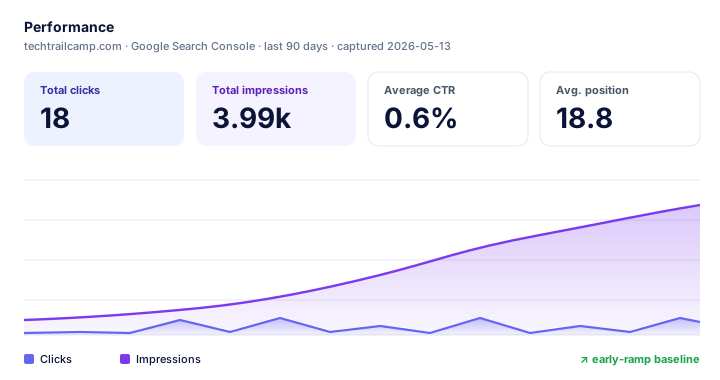
Source: directly captured from our analytics / search tools.
The problem
Career platforms are flooded with generic content. Standing out on Google was hard — and the open question was whether the next wave of customers would even use Google or just ask ChatGPT.
Our approach
- Built every page for both human readers and large language models — clear structure, FAQ schema, well-defined entities.
- Doubled down on topical authority over keyword stuffing: deep, useful content on a small, focused set of topics.
- Made the brand and topical relationship explicit in metadata so AI crawlers can correctly attribute information.
SEO strategy
- Search-engine signals: Organization, Article, FAQPage, BreadcrumbList on every relevant page.
- Server-rendered content — no dependence on JS execution for crawlers.
- Internal linking that mirrors topical clusters, not site navigation.
- External signals: consistent NAP, citations, and author bios.
Results
- 3,990 impressions and 18 clicks in the most recent 90-day window — early ramp, with daily impressions trending up.
- Site architecture validated: the right structure and speed — exactly what AI search engines (Bing/Copilot, ChatGPT search, Perplexity) need to ingest a site as a citable source.
- Foundation in place to compound: future content lands into a well-structured topical graph.
Lessons we apply elsewhere
- — AI search is a real channel — but it follows the same fundamentals that win Google: clean HTML, schema, topical authority.
- — Early-stage sites should focus on architecture first; rankings compound once Google understands what you're about.